Choose for the life of the display
Imagine two organizations ordering equally tall dimensional letters. One needs a dramatic backdrop that travels to several indoor events; the other wants a recognizable landmark beside a campus entrance for years to come. Their photographs might show similar shapes, yet the sensible construction choices can be very different. Giant foam letters and metal letters are not competing answers to every possible brief. They offer different ways to manage scale, weight, surface appearance, contact, weather, transport, and long-term ownership. The better choice emerges when those requirements are made explicit and the complete installed assemblies are compared. For buyers, the challenge is to avoid deciding from appearance alone or treating one material as a universal upgrade. A display should be judged by how well it communicates in its setting, how reliably it can be installed and handled, and what its owner will need to do to keep it useful.
A: Compare total handling weight, packing, venue access, assembly, and finish care; foam can be a useful starting option.
A: No. Size, complete weight, supports, and the agreed handling method still govern movement.
A: They can be hollow, framed, cut from plate, or otherwise fabricated; request the actual construction description.
A: Yes, though close viewing, edges, texture, and reflections may reveal important differences.
A: Suitability depends on the specified complete assembly and exposure; do not generalize from the core alone.
A: Stability and support must be resolved for the actual geometry, interaction, and site conditions.
A: A mixed construction or modular design may address different requirements in different components.
A: Request matching installed scopes and identify which requirements explain any construction differences.
A: No. Both options need handling and protection appropriate to the proposed display.
A: Choose the complete solution whose appearance, installation, care, and costs fit the intended use.
A useful comparison starts with the same brief
Give both options the same message, approximate dimensions, location, lifespan, and expected interaction before asking which is best. A low-cost indoor foam proposal and an engineered permanent metal installation are not equivalent products, even when their letter heights match. Likewise, a coated foam assembly with substantial support should not be compared to a bare cutout solely by the material name. State what the audience will do around the display and who will move or maintain it. Then ask each supplier to explain the complete construction, installation scope, and care requirements. This approach produces a decision about a usable display rather than an argument over raw materials.
| Decision | Foam proposal | Metal proposal |
|---|---|---|
| Surface contact | Specify coating and permitted handling | Specify finish and treatment of exposed edges |
| Repeated transport | Confirm protection, repair, and packaged volume | Confirm component weights, lifting, and packing |
| Outdoor use | Require a documented exterior assembly | Require suitable alloy, joints, finish, and mounting |
| Ownership | Identify touch-up and replacement arrangements | Identify finish care and access to components |
Foam can make temporary scale practical
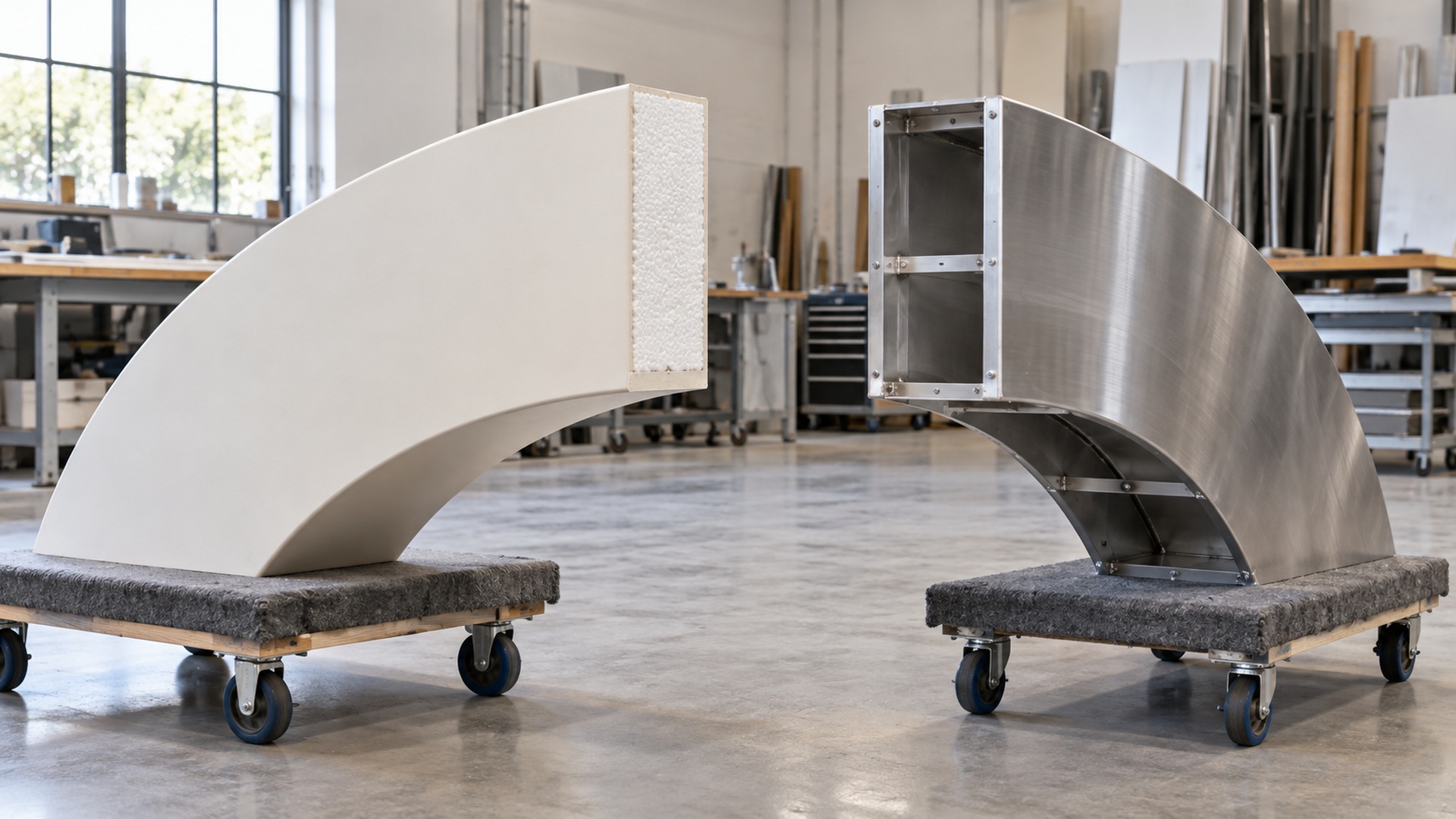
Lightweight foam construction can be attractive when a project needs large dimensions without imposing the handling burden of a comparable heavy assembly. Event teams may need to reposition letters between a stage and a photo area or move them through changing exhibition layouts. Lower body weight can help, although the finished base and reinforcement still count in the handling plan. Ask for the weight of the complete component and the proposed lifting method. Do not infer that one person can safely move a giant object simply because its core is foam.
Foam also provides a route to sculpted shapes and painted appearances. A smooth monochrome body, textured surface, or faux-metal finish may achieve the visual goal without requiring the exposed face to be solid metal. The success of that approach depends on viewing distance and the agreed finish standard. A surface seen across an auditorium can have different expectations from a closely examined lobby feature. Review a sample under representative light and identify which edges, seams, and side surfaces will remain visible. Appearance should be assessed at the scale and distance of the actual encounter.
The main tradeoff is that handling and contact need careful consideration. Protective coatings and support can improve an assembly’s suitability, but they should be specified rather than assumed. Thin strokes and projecting details may be vulnerable to packing mistakes or repeated bumps. A traveling display needs protection that the event crew can realistically use, along with instructions for setup and storage. Ask which repairs are straightforward and which would require a replacement component. The purchase becomes easier to evaluate when the supplier connects the proposed foam construction to the particular event routine.
Metal can support a lasting physical presence
Metal letters may suit installations where permanent placement, a specific exposed-metal appearance, or a more substantial construction approach serves the brief. They can be fabricated in different alloys and forms, so their performance cannot be described by the word metal alone. Hollow bodies, welded assemblies, cut plate characters, and framed structures are distinct proposals. Ask how the selected construction meets the project’s scale, location, and public-use conditions. The visible face is only part of the decision; mounting, connections, surface protection, and access must work with it.
Greater weight can add handling complexity without automatically providing the correct stability. A tall letter’s shape and support arrangement still matter, particularly outdoors or in areas where people approach closely. The fabricator and installer should resolve those conditions for the site rather than relying on the impression of mass. Delivery may require different equipment, and the final placement may be difficult to change once the display is installed. Confirm how that affects site preparation, lifting, assembly, and future removal. A lasting presence should be planned as a lasting installation, not merely purchased as a heavier object.
The environment tests the whole construction
Outdoor exposure is a major reason to compare complete systems rather than material labels. Rain, sunlight, temperature changes, accumulated moisture, and local conditions affect finishes and hidden parts as well as visible faces. Some foam assemblies can be specified for exterior use, while some metal proposals still need substantial protection and maintenance. Ask what conditions the particular construction is intended to handle and what care is required. Avoid treating a temporary outdoor event as evidence that the same product will perform identically in a permanent exposed location.
Indoor settings have their own challenges. High-contact photo areas can introduce abrasion, while moving crews can damage projecting edges during frequent setup. Food service, cleaning routines, dust, and nearby equipment may influence surface selection. A display placed behind a controlled reception counter experiences a different life from one in the middle of a busy lobby. Describe those conditions to each supplier, then compare the finish and protection proposed for them. The choice should respond to actual use instead of assuming indoor means that durability is irrelevant.
A protected sample can demonstrate color and texture, but it does not by itself explain how the full letter handles exposure. Review the proposed edges, joins, mounting details, and any lighting openings with the supplier. Clarify what inspection or repair would be needed after damage and which visible changes are expected over time. If several organizations share responsibility for the site, determine who owns those tasks. A material that performs well with regular care may become a poor operational choice when no one has the resources or responsibility to provide that care.
Appearance can overlap while the assemblies differ
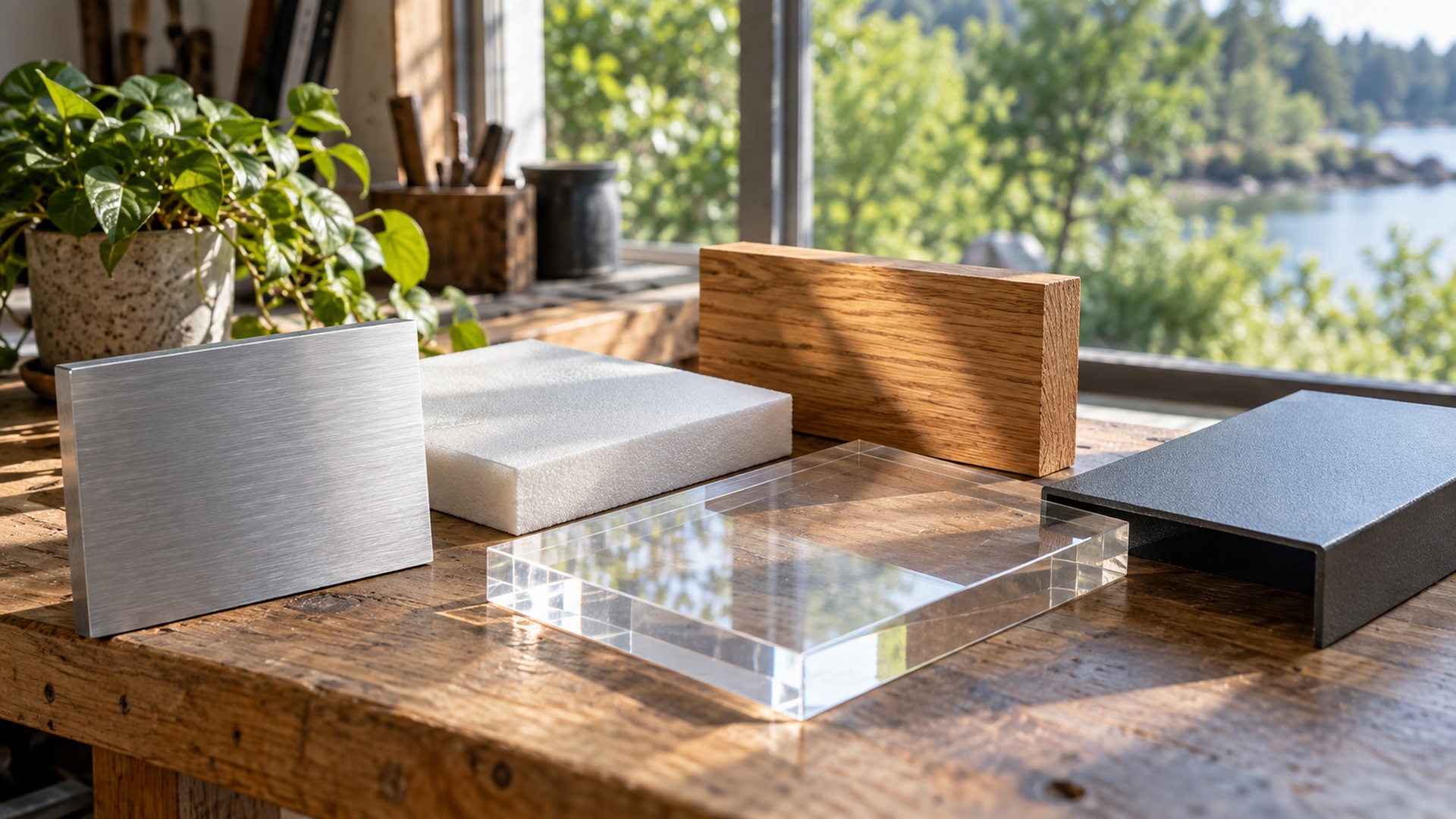
Foam and metal can sometimes produce similar photographs, particularly when both are painted with the same color and photographed from the front. The resemblance may disappear at close range, along a polished edge, or where light reveals texture and reflections. Decide whether the audience needs a particular material experience or simply a particular visual effect. If genuine exposed metal is central to the concept, a faux finish may not satisfy the brief; if the goal is a large temporary painted word, it may. Compare physical samples and side views, and be clear about which differences matter to the audience rather than paying for an attribute they will never encounter.
Transport may decide a touring display
Imagine a touring programme using the same one-metre-high word at twelve indoor events. Give the foam and metal suppliers that identical brief, including the access route, available crew, storage space, and expected public contact. Request packaged dimensions and weights for each complete proposal; raw material labels cannot tell you how much room its crates occupy. Ask the crew to rehearse unpacking, assembly, and repacking a representative component. Compare that recurring work across twelve setups. A lower initial quote may offer little advantage if the proposal adds difficult handling or requires frequent finish repairs.
Modularity can change the comparison. Separate characters may be easier to distribute among crates, while a shared assembly can reduce alignment work on site. A modular metal installation and a one-piece foam word can therefore have different logistical advantages from those suggested by their materials. Review the access route at the smallest anticipated venue and test how the setup sequence fits the event schedule. Confirm that the supplied hardware and packing instructions make sense to the crew who will actually use them. A design that depends on exceptional handling skill may be unsuitable for a changing touring team.
Price should include the work of ownership
Request quotations with comparable inclusions: letter bodies, supports, finish, hardware, packing, freight, and any installation work. Do not assume that the lower visible-body price produces the lower installed cost. If one option requires site work or additional equipment, include that scope in the comparison. Ask which design features contribute most to the price and which can be simplified without losing the purpose of the display. Adjusting depth, finish, lighting, or overall scale may produce a more useful savings than choosing a material unsuited to the job.
Maintenance and repair deserve realistic estimates as well. A foam finish may need attention after handling damage; a metal assembly may need care of its finish, joints, or lighting components. The details depend on the actual product and environment, so avoid a universal promise of either carefree foam or maintenance-free metal. Ask how a damaged character is repaired, whether a component is replaceable, and how long the display would be unavailable. For a prominent entrance, that downtime may have consequences beyond the repair invoice.
Storage and reuse also contribute to value. An event display used once has a different cost pattern from one that supports a series of activations. Protective packing, replacement hardware, setup labor, and freight can accumulate across the series. A permanent installation has another pattern, involving site maintenance and eventual removal or refurbishment. Decide which scenario applies before estimating value. The material decision becomes clearer when its costs are placed along the expected life of the display rather than concentrated entirely on the moment the order is placed.
Review a representative component before committing
A comparison becomes more concrete when you can examine a representative built detail rather than unrelated swatches. Ask how a visible corner, side return, seam, or mounting connection would be handled in each proposal. Compare the samples at the likely viewing distance and under lighting similar to the intended setting. A lightweight finish may be entirely convincing for a stage application but less suitable when the concept depends on a close encounter with exposed material. Conversely, a refined metal sample may offer an appearance the audience will rarely see in a large distant installation. Use the review to identify which differences justify their practical and financial consequences, and document the chosen standard so production is evaluated against an agreed result instead of a vague memory of the sample.
Select the option whose tradeoffs you can manage
Now consider a permanent word outside a visitor centre. Compare foam and metal against the same exterior brief, rather than importing the touring programme’s priorities. Each supplier should document how its complete assembly addresses the site’s exposure, support, public contact, and maintenance access. A protective coating alone does not settle those questions, and a metal face does not identify the rest of the structure. The buyer can then compare the installed proposals and the care each requires. The preferred answer may differ from the touring example because the work demanded of the display has changed.
Make the decision in terms the owner can act on: this assembly suits this location, this crew can handle it, and these maintenance tasks are acceptable. Keep the sample approval and the installed scope with the purchasing record. If a mixed construction best meets the brief, describe which material performs each role. The value of the comparison lies in exposing responsibilities before purchase. It should leave the organization with a workable display and a clear account of the tradeoffs it has accepted.